science
Research interests and contributions
During my studies in mathematics and computer science I already worked as a research assistant before conducting a PhD between 2020 and 2024 about modeling and simulation of dynamical systems – applied to biomedical research. During these years, I could develop a broad understanding of modeling, system dynamics, and general scientific thinking that extends far beyond a single discipline. After defending my doctoral thesis, I continued my academic work as a postdoctoral researcher and later as a guest researcher while transitioning into industry. A record of scientific contributions can be seen below.
 Publication
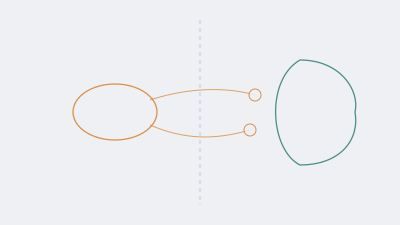
Environmental Cues Shape Extracellular Vesicles Biogenesis and Function in Streptococcus pneumoniae
(2026) Combines quantitative image and data analysis with experimental characterization to show how environmental conditions shape the biogenesis of extracellular vesicles released by Streptococcus pneumoniae.
 Publication
Mechanistic Insights into the Role of Extracellular Vesicles at the Bacterial–Host Interface
(2025) A mechanistic review synthesizing computational and experimental models of how bacterial extracellular vesicles mediate signaling at the host interface.

Mathematical Modeling of Spatiotemporal Host Defense Mechanisms Against Pulmonary Fungal Infections
(2024) PhD thesis applying agent-based & continuum simulations plus advanced analytical methods to model the spatiotemporal dynamics of the innate immune defense against Aspergillus fumigatus spores in the human lung.
 Publication
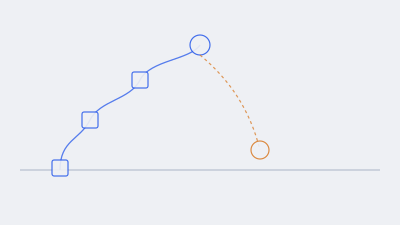
Unique Target Binding by the C-Terminal Region of FHR1 Provides a New Perception of aHUS Pathology
(2024) Combines structural (geometric) modeling with quantitative binding-assay data analysis to characterize how the C-terminal domain of FHR1 drives aHUS pathology.
 Publication
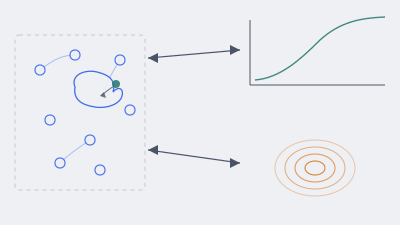
Spatiotemporal Modeling Quantifies Cellular Contributions to Uptake of Aspergillus fumigatus in the Human Lung
(2024) A spatiotemporal, geometry-resolved simulation of the alveolar space quantifying each immune cell type's contribution to the uptake of inhaled Aspergillus fumigatus conidia.
 Publication
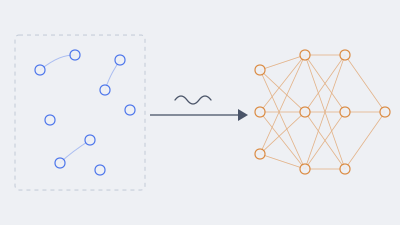
Surrogate Infection Model Predicts Optimal Alveolar Macrophage Number for Clearance of Aspergillus fumigatus Infections
(2023) Builds a reduced-order surrogate simulation of macrophage population dynamics to efficiently predict the alveolar macrophage number that best clears Aspergillus fumigatus infection.
 Publication
Invasive Aspergillosis-on-Chip: A Quantitative Treatment Study of Human Aspergillus fumigatus Infection
(2022) Pairs a microfluidic organ-on-chip platform with computational, quantitative image analysis to run a controlled treatment study of invasive Aspergillus fumigatus infection.